
Fence Ideas are everywhere on Pinterest right now. So many gardeners want privacy without losing style. Since fencing shapes the whole feel of an outdoor space, it is worth getting right. A good fence can frame planting, hide an eyesore, or give climbers something to work with.
These 7 fence ideas cover real gardens with real materials. Some work on a tight budget, while others lean into natural wood and painted finish combinations. I have made the mistake of skipping this step before. First, look at what each design actually does to the space around it.
Fence Ideas Along a Mixed Cottage Border
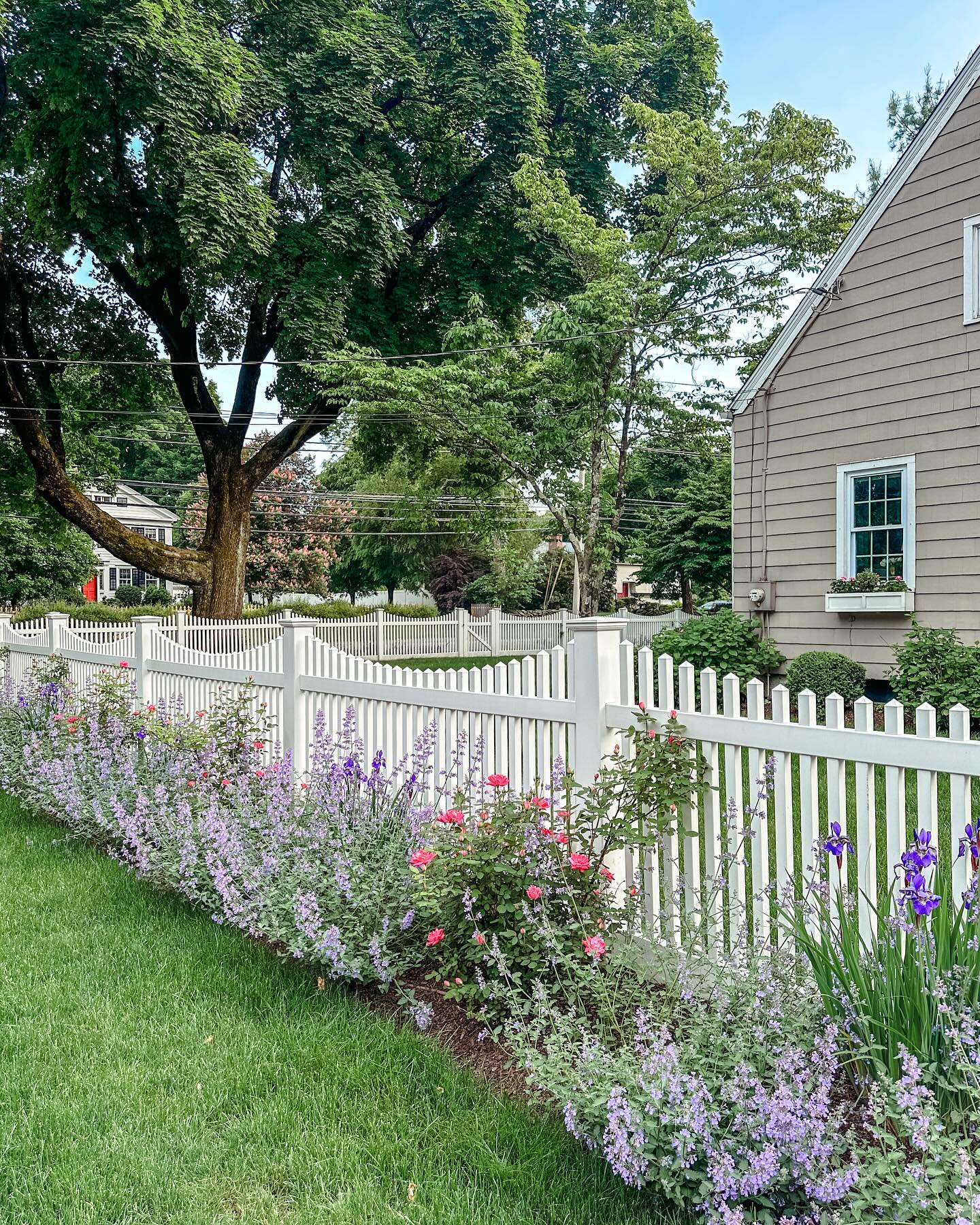
A white picket fence runs the full length of this side garden, and the planting bed sits tight against it. Catmint (*Nepeta* sp.) spills forward in soft lavender-blue waves, roughly eighteen inches wide along the base. Pink roses push up through the middle layer, maybe four feet tall. Tall purple spikes, probably *Salvia nemorosa*, repeat at least three times down the run, holding the eye along the fence line.
Make It Work
- Plant catmint at the front edge in drifts, since it naturally spills forward over lawn without needing an edging board.
- Echo one vertical plant, such as the purple salvia here, at roughly every six feet so the border reads as one planting rather than a jumble.
- Roses sit mid-border, about halfway between the fence and the lawn edge, so they don’t swamp the lower catmint.
- White vinyl or painted timber gives a backdrop that makes cool-toned purples and pinks pop without extra effort.
- These fence ideas work best when the bed is at least two feet deep, because a shallow strip cramps the catmint and crowds the roses.
- Iris (*Iris germanica*) in deep purple appear at the right edge, also spilling slightly forward, adding a third vertical accent to close the bed.
Roses Running the Full Fence Line
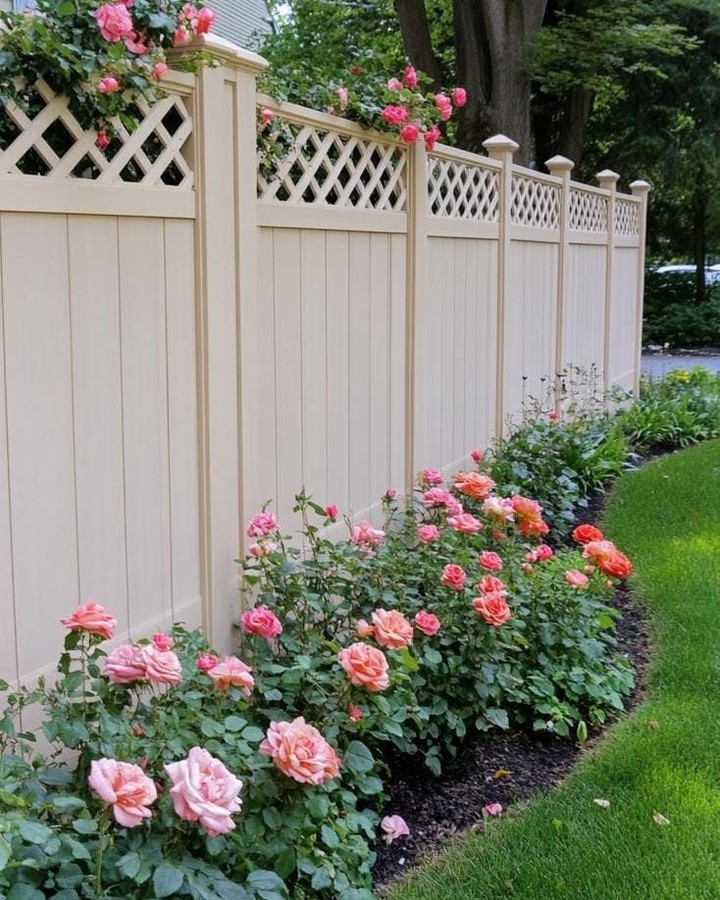
The cream vinyl fence does two jobs at once. It gives the bed a flat backdrop, so every pink bloom reads clearly against it. Since the lattice panel runs the full top section, climbing roses can grip and spill above the solid boards below. I counted at least a dozen shrub rose plants running the length, each spaced roughly two feet apart.
Pink and coral roses carry the eye down the border in one long sweep. Some blooms fully open. The bed sits about three feet deep, edged cleanly in dark mulch with no gravel or stone visible. These Fence Ideas suit a long straight run, but anything under ten feet risks looking crowded fast.
Fence Ideas with Cedar and Black Steel Posts
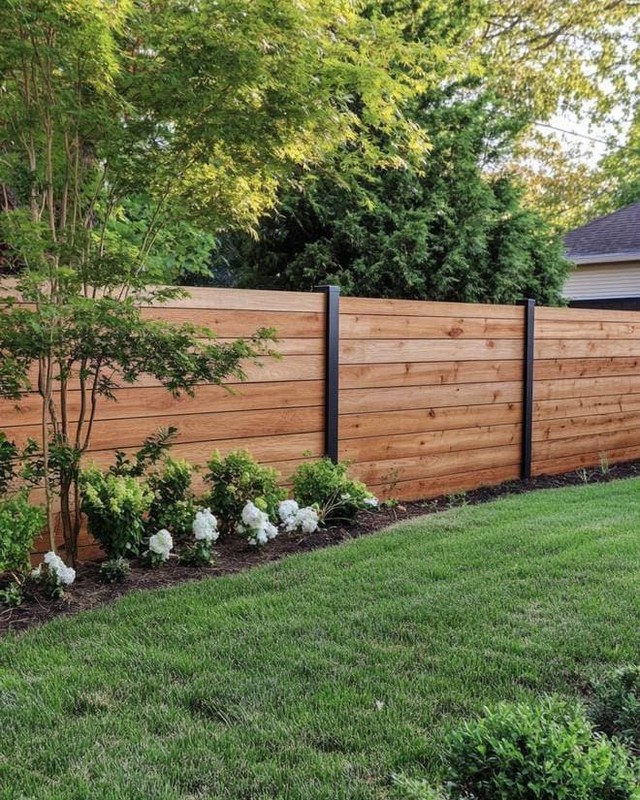
Want a fence that reads clean but still feels warm? Horizontal cedar boards run the full panel length here, stained to a rich mid-brown with a slightly orange cast. Black steel posts sit at roughly six-foot intervals, and I love how sharply they cut against the warm wood. Along the base, a planted bed layers small white mop-head blooms, a multi-stem shrub with fine red-green foliage, and low rounded evergreens massed three or four plants deep.
These fence ideas suit a mid-range budget, since the steel post system and cedar boards together run more than a basic picket. Big space wins here. The cedar will need a fresh coat of stain every two or three years, especially in a wet climate, so factor that in before committing. A smaller yard could still pull this off with one panel section rather than a full run.
Lollipop Topiary Along a Timber Fence

Standing here feels oddly calm. The horizontal cedar fence runs behind everything, warm and even, giving the planting a clean backdrop. White flower spikes rise in front of it, dense enough that they almost hide the soil. I find myself wanting to walk the full length, because each bay lollipop pulls the eye steadily along.
These Fence Ideas rely on one repeated move: a row of ball-trained bay (*Laurus nobilis*) standards, each globe roughly 40 to 45 cm across, spaced about 1.8 metres apart. At their feet, a white-flowering plant with upright spikes and strap-like leaves fills the full bed width, possibly a white liriope or a *Libertia grandiflora*. The dark mulched soil between clumps reads almost black, which makes the white blooms sharper. One honest note: lollipop bays clip to this shape easily, but clay soil holds water around the roots and they will sulk fast.
Fence Ideas with a Curved Mulch Bed
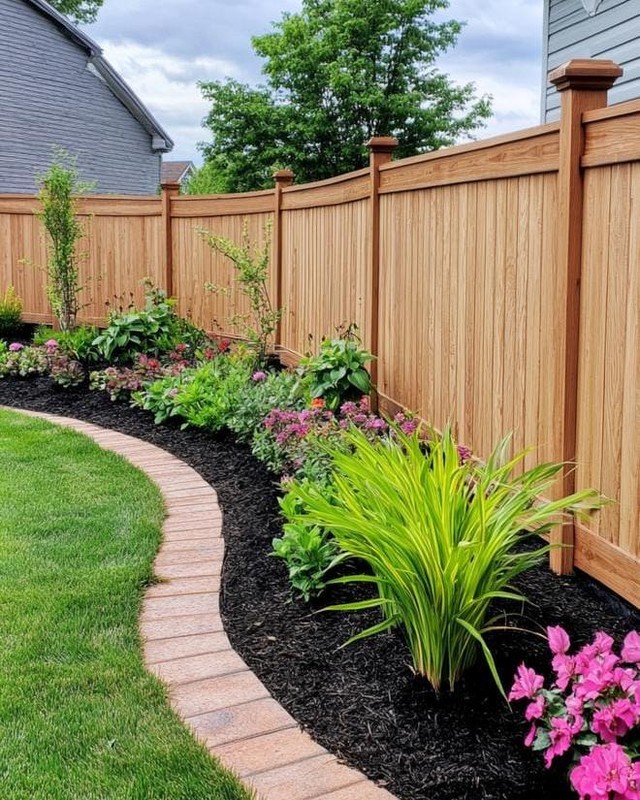
The bed curves. Black mulch defines a crisp edge against the green lawn, and a curved brick border traces the whole sweep. Lime-green ornamental grass anchors the near corner, its blades roughly eighteen inches tall. Pink flowers cluster in two spots, while broad-leafed hostas fill the shadier middle ground behind them.
First comes the fence itself: warm cedar-toned vinyl panels with decorative post caps, running the full back of the bed. Fence Ideas like this one pair best with tiered planting so the fence stays visible above the foliage. I almost always see the mid-layer dropped too low, flattening the whole border. Next, a young upright tree near the far post gives the eye somewhere to travel.
Planting Notes
- Lime-green grass clump in the foreground reads as the thriller in a thriller-filler-spiller layout, sitting around eighteen inches at this stage.
- Hostas work well mid-border. Space them twelve to eighteen inches apart at planting.
- Bright pink blooms near the path edge look like dianthus or phlox, both of which repeat-flower through summer in zones 4 to 8.
- Dark mulch sets off pale and chartreuse foliage. One cubic yard covers roughly a hundred square feet at three inches deep.
- The brick edging strip, maybe four inches wide, keeps lawn grass from creeping into the mulch bed.
- That young upright tree near the fence corner will eventually soften the top line of the panels, but right now it leaves a gap.
Horizontal Cedar with Gravel Planting Strip
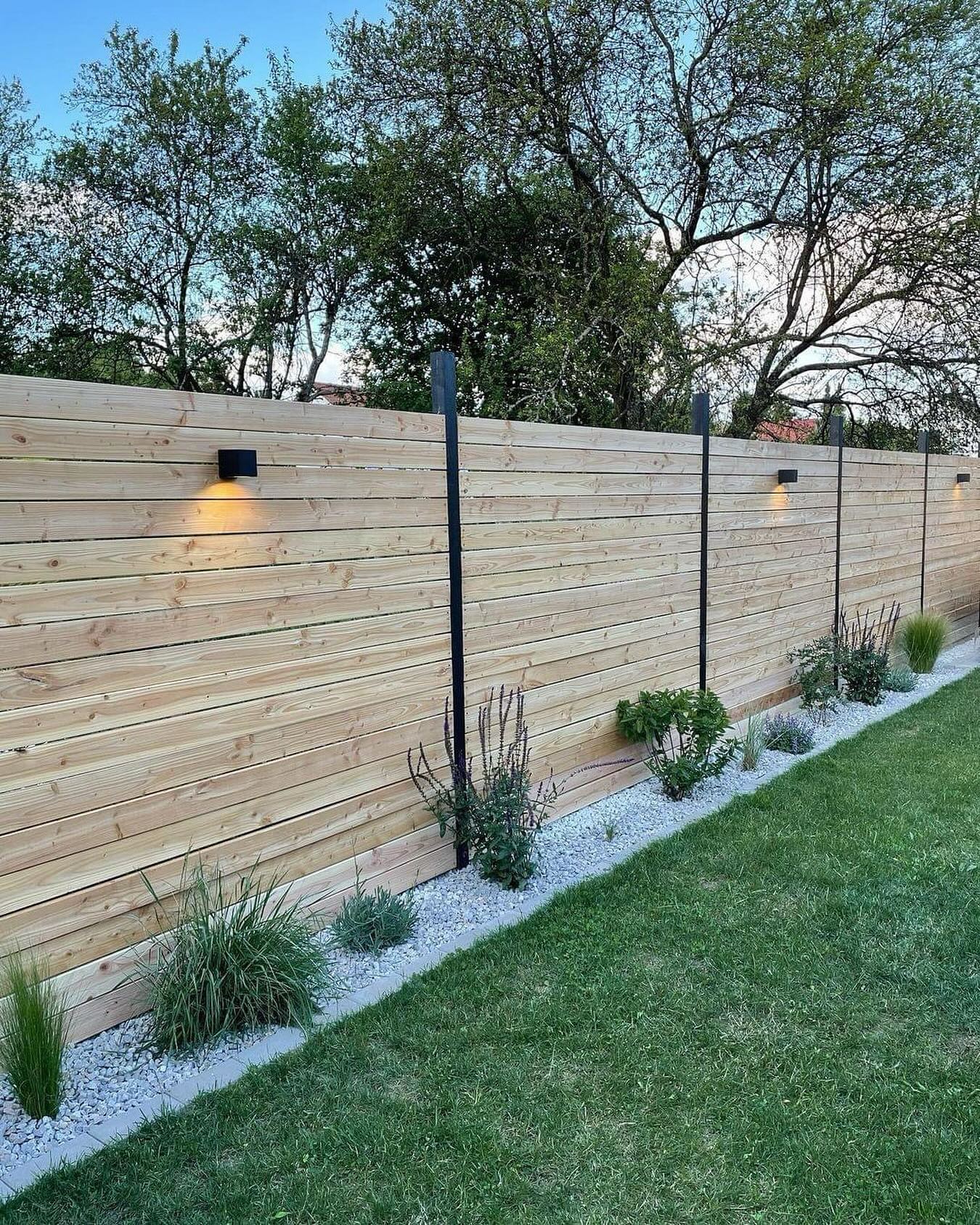
Horizontal cedar boards run the full fence length, pale and fresh, not yet weathered grey. Black steel posts interrupt the boards at roughly six-foot spacing. Each post rises a few inches above the top rail, which I actually like. Small matte black wall sconces sit near the top of the fence, already glowing warm amber, so the border reads well after dusk too.
White gravel lines the planting strip, maybe eighteen inches deep, with ornamental grasses massed at each end. Low silver-leafed plants, probably a salvia or similar upright herb, dot the middle section. Bare patches show between a few clumps, since this planting looks new and will fill in over the next season. These Fence Ideas suit a narrow side yard especially well, but a large dog would scatter that gravel fast.
Standard Trees Against a Slatted Blue Fence
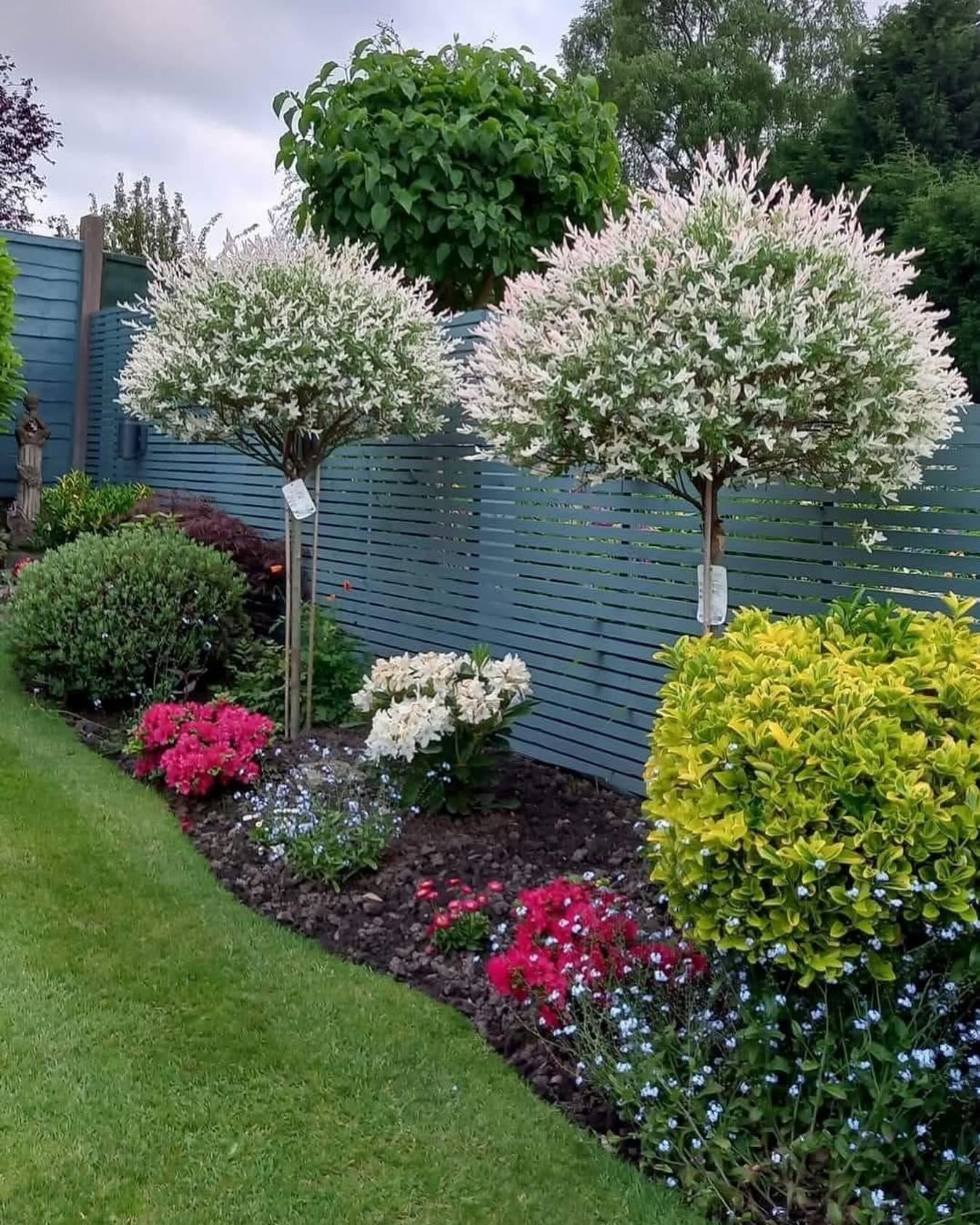
Two standard trees anchor this border. Each grows roughly five to six feet tall, trained into tight round canopies packed with small white variegated leaves. Pink azaleas (Rhododendron) cluster at the base, while pale blue forget-me-nots (Myosotis) spill across the dark mulch between them. A round golden euonymus shrub sits at the right end, its lime and cream foliage reading almost yellow in the grey light.
Start with the slatted teal fence as your backdrop, because that flat cool colour makes white canopies jump forward. Buy standard trees already trained on a single clear stem, since growing them yourself from scratch takes four to six years. Plant azaleas no closer than eighteen inches apart so each mound keeps its shape. Budget around forty to sixty pounds per standard tree at a garden centre, but Fence Ideas like this repay that cost for a decade.
✨ Designer Tip: The dark mulch here runs right to the lawn edge with no kerb stone, so mow carefully or that clean line goes ragged within a week. A simple steel lawn edging strip buried flush solves it.
Final Thoughts
Pick one of these Fence Ideas and start there. Seven changes at once usually ends in a muddy, expensive mess, so choose the single style that fits your garden now. I always say the post spacing matters more than the paint color, since uneven gaps read as sloppy from ten feet away. Save this post, then drop a comment telling me which fence style you are trying first.